Why Fundraising Without Accountability Is No Longer Enough
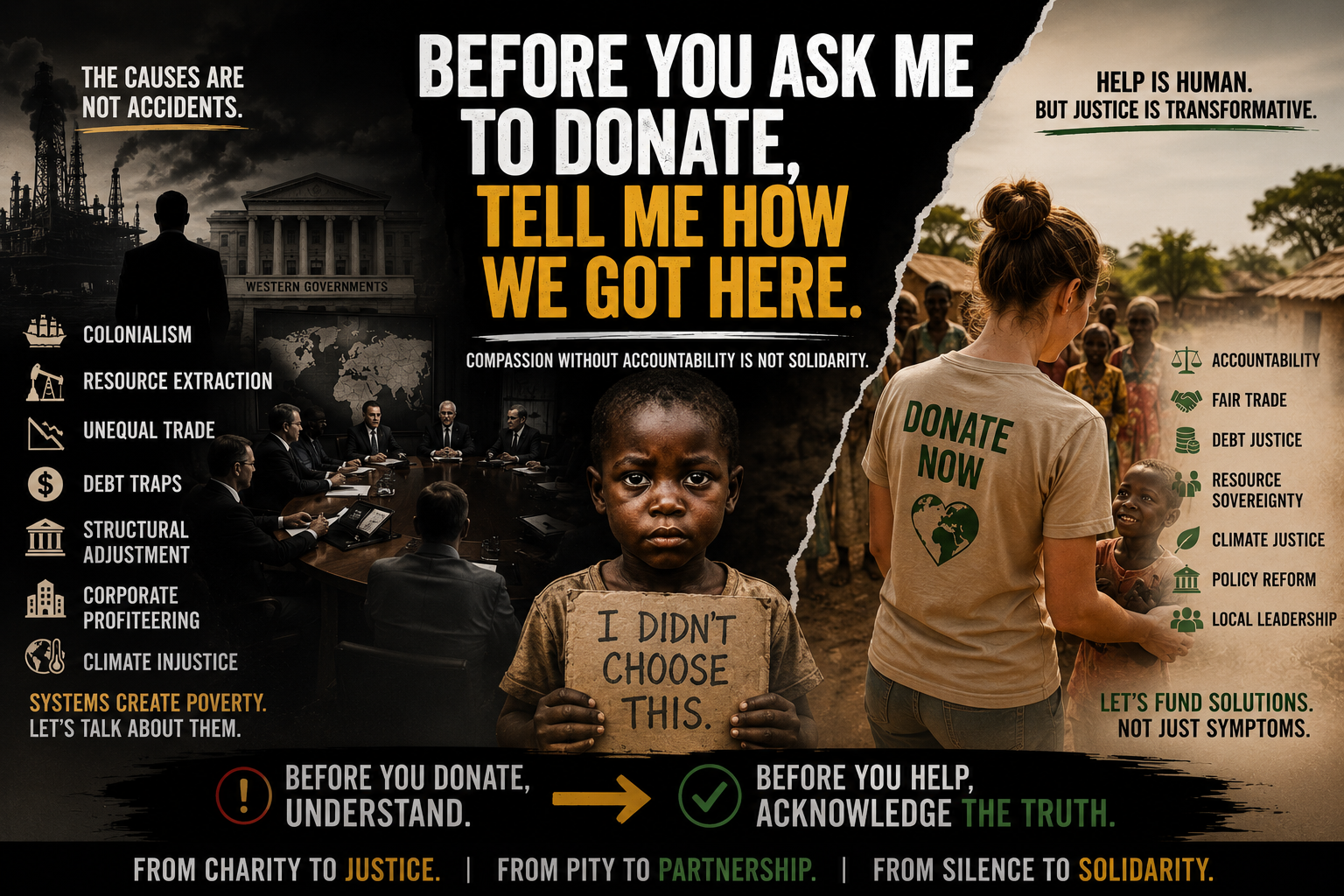
Before You Ask Me to Donate, Tell Me How We Got Here
Why Charity Without Accountability Leaves a Bitter Taste
Every few months I see another fundraising campaign.
A white celebrity standing next to African children.
A young volunteer holding a malnourished baby.
A narrator speaking about hunger, poverty, lack of clean water, or the need for education.
The message is always clear:
Africa is suffering.
Please donate.
And every time I see these advertisements, I feel two emotions simultaneously.
Compassion.
And discomfort.
The compassion is easy to understand. No human being should be indifferent to the suffering of a child. Hunger is real. Preventable disease is real. Lack of access to clean water is real. Communities struggling to provide education and healthcare deserve support.
But the discomfort comes from a different place.
It comes from what is missing.
Because before I am asked to donate, I want someone to explain how we got here.
The Story Begins in the Middle
Most fundraising campaigns begin with suffering.
They show us the consequences.
They rarely show us the causes.
The child appears on the screen.
The village appears on the screen.
The empty classroom appears on the screen.
But the story often begins decades—or even centuries—earlier.
It begins with colonial occupation.
It continues through resource extraction.
It evolves through unequal trade relationships.
It is reinforced by debt structures.
It is maintained through international financial institutions, multinational corporations, and global economic arrangements that frequently benefit some regions of the world more than others.
Yet when the fundraising appeal arrives, history disappears.
The audience is invited to witness the wound.
Not the knife.
Why This Matters
For decades, many African countries have been told that development requires following a particular economic model.
International institutions such as the IMF and the World Bank have often promoted policies involving privatization, market liberalization, debt repayment, and reductions in public spending.
Supporters argue that these policies encourage growth and economic stability.
Critics argue that they frequently weaken public services, increase dependency, and reduce governments’ ability to invest in healthcare, education, agriculture, and social protection.
Whether one agrees with every criticism or not, one fact remains:
These policies are not neutral.
They shape lives.
They shape economies.
They shape futures.
Yet when the consequences appear, we are encouraged to discuss charity rather than policy.
We discuss symptoms rather than systems.
The Child and the Mining Contract
One of the most revealing questions we can ask is this:
Why does every fundraising campaign begin with a hungry child?
Why does it almost never begin with a mining contract?
Why does it rarely begin with a debt agreement?
Why does it rarely begin with discussions about capital flight, tax avoidance, commodity pricing, or structural adjustment programs?
The answer is uncomfortable.
A hungry child generates compassion.
A mining contract generates questions.
Compassion opens wallets.
Questions challenge power.
And power rarely enjoys being questioned.
The Business of Benevolence
This is where many people become uncomfortable.
Because the issue is not whether people should help.
The issue is whether helping has become disconnected from accountability.
The late Pan-African leader Kwame Nkrumah warned in Neo-Colonialism: The Last Stage of Imperialism that political independence does not necessarily mean economic freedom.
Walter Rodney argued in How Europe Underdeveloped Africa that underdevelopment was not simply the absence of development. It was the result of historical processes that systematically transferred wealth, labor, and resources out of Africa.
More recently, Dambisa Moyo challenged conventional aid models in Dead Aid, arguing that decades of aid have often failed to produce the outcomes promised.
These scholars do not all agree with one another.
But they share an important insight:
Poverty cannot be understood separately from power.
And yet power is precisely what many fundraising campaigns avoid discussing.
The White Savior and the Politics of Innocence
Writer Teju Cole introduced the concept of the “White Savior Industrial Complex.”
His argument was not that helping people is wrong.
His argument was that helping can sometimes become a substitute for justice.
A person can feel morally fulfilled by donating to a project in Africa without ever asking how their government, corporations, trade policies, investment structures, or consumption patterns may be connected to the conditions they are helping to alleviate.
Charity becomes a way to treat symptoms while leaving causes largely untouched.
The donor feels good.
The structure remains.
The campaign succeeds.
The system survives.
What Ethical Fundraising Could Look Like
Imagine a different fundraising campaign.
Imagine the advertisement begins with honesty.
Imagine it says:
“Before we ask you to donate, we would like to explain how colonial history, unequal economic relationships, debt structures, resource extraction, climate injustice, and global power imbalances have contributed to the challenges facing this community.”
Imagine if donors were invited not only to give money but also to ask questions.
Imagine if solidarity included political education.
Imagine if compassion required accountability.
Imagine if fundraising organizations spent as much time explaining systems as they spend showing suffering.
That would be transformative.
Because it would shift the conversation from charity to justice.
From Pity to Partnership
Africa does not need pity.
Africa does not need another generation of children growing up seeing themselves represented primarily through images of poverty.
Africa does not need to remain the world’s fundraising backdrop.
What Africa needs is a global conversation mature enough to connect suffering to its causes.
A conversation willing to ask difficult questions about debt, trade, extraction, climate responsibility, taxation, corporate power, and historical accountability.
A conversation that recognizes Africans not as objects of rescue but as subjects of history.
As thinkers.
As leaders.
As partners.
Before You Ask Me to Donate
So the next time I see a fundraising campaign, I will still care.
I will still want children to eat.
I will still want communities to have clean water.
I will still support efforts that genuinely improve lives.
But I will also ask:
Why is the child on my screen, but the history is not?
Why am I being shown the consequences, but not the causes?
Why am I being asked to fund the symptoms while remaining silent about the system?
Before you ask me to donate, tell me how we got here.
Then we can have a conversation not only about charity.
But about justice.
Suggested Reading
- How Europe Underdeveloped Africa – Walter Rodney
- Neo-Colonialism: The Last Stage of Imperialism – Kwame Nkrumah
- Dead Aid – Dambisa Moyo
- The Divide – Jason Hickel
- Confessions of an Economic Hit Man – John Perkins
- The Wretched of the Earth – Frantz Fanon
- Teju Cole – The White Savior Industrial Complex (essay)